
Art: Sam-i-naki Passah | Text: Jessica Jakoinao
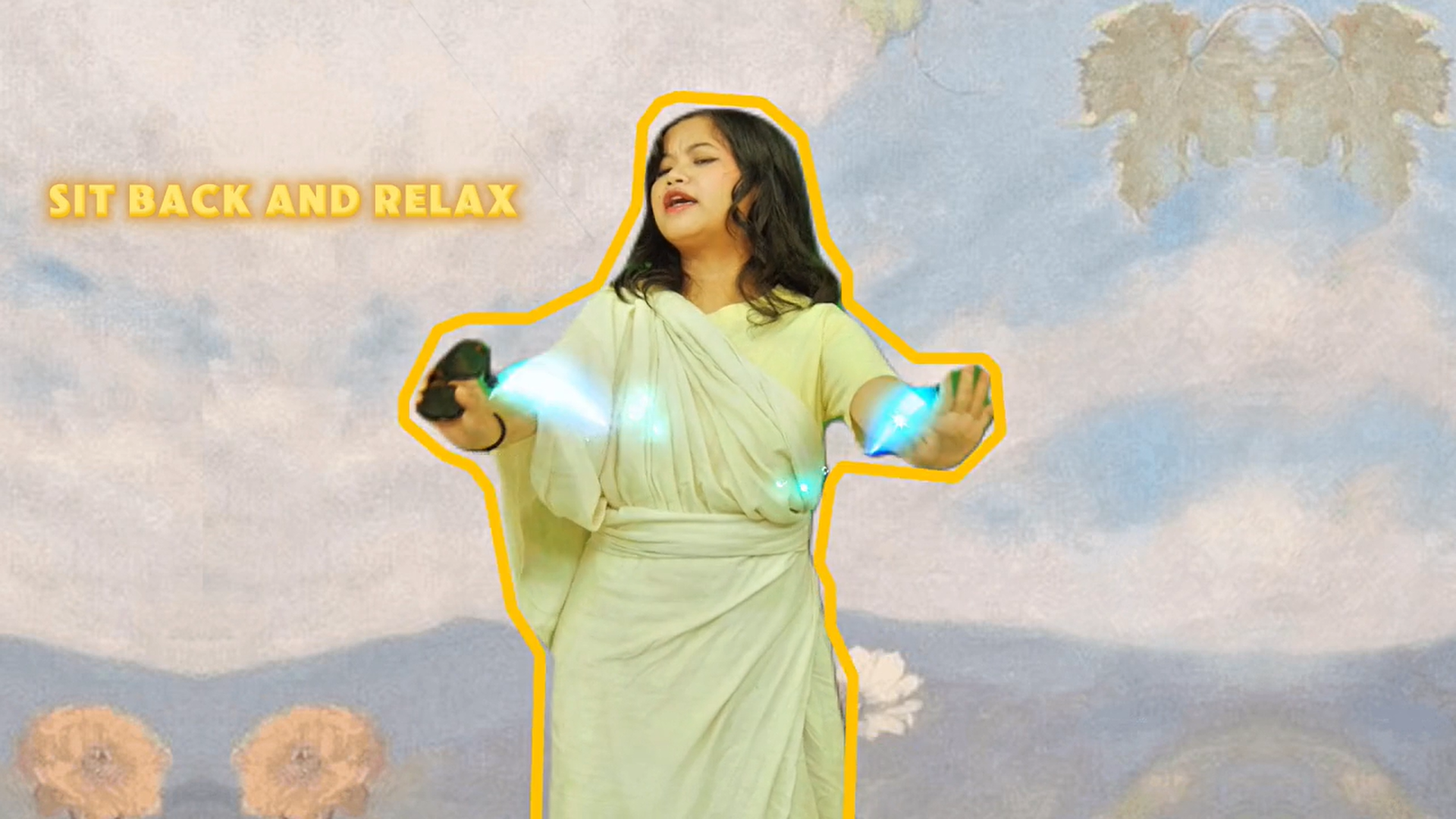
After a spree of posting poems on my Instagram, some time back in 2020, I was once told—quite casually—that writing songs couldn’t be that different from writing poems. A local pop artist, in search of lyricists, suggested I try, that too, a heartbreak song.
What came out were two songs that refused to be songs, “The Spinner” and “Before It Cools”. They had lyrics, technically. They had rhythm, in the way poems have syllabic meters. However, no musician could set them to music. Not because they were radical, or experimental, or ahead of their time but because they simply did not cohere. And there were just too many intertexts of a German folktale and an inside joke of the commissioning musician, producer and sound engineer being perpetually harassed with people asking him to DJ events. Although the singers assured me it was their work schedules or that it just was not their style. But apparently Bob Dylan would have been down for it.
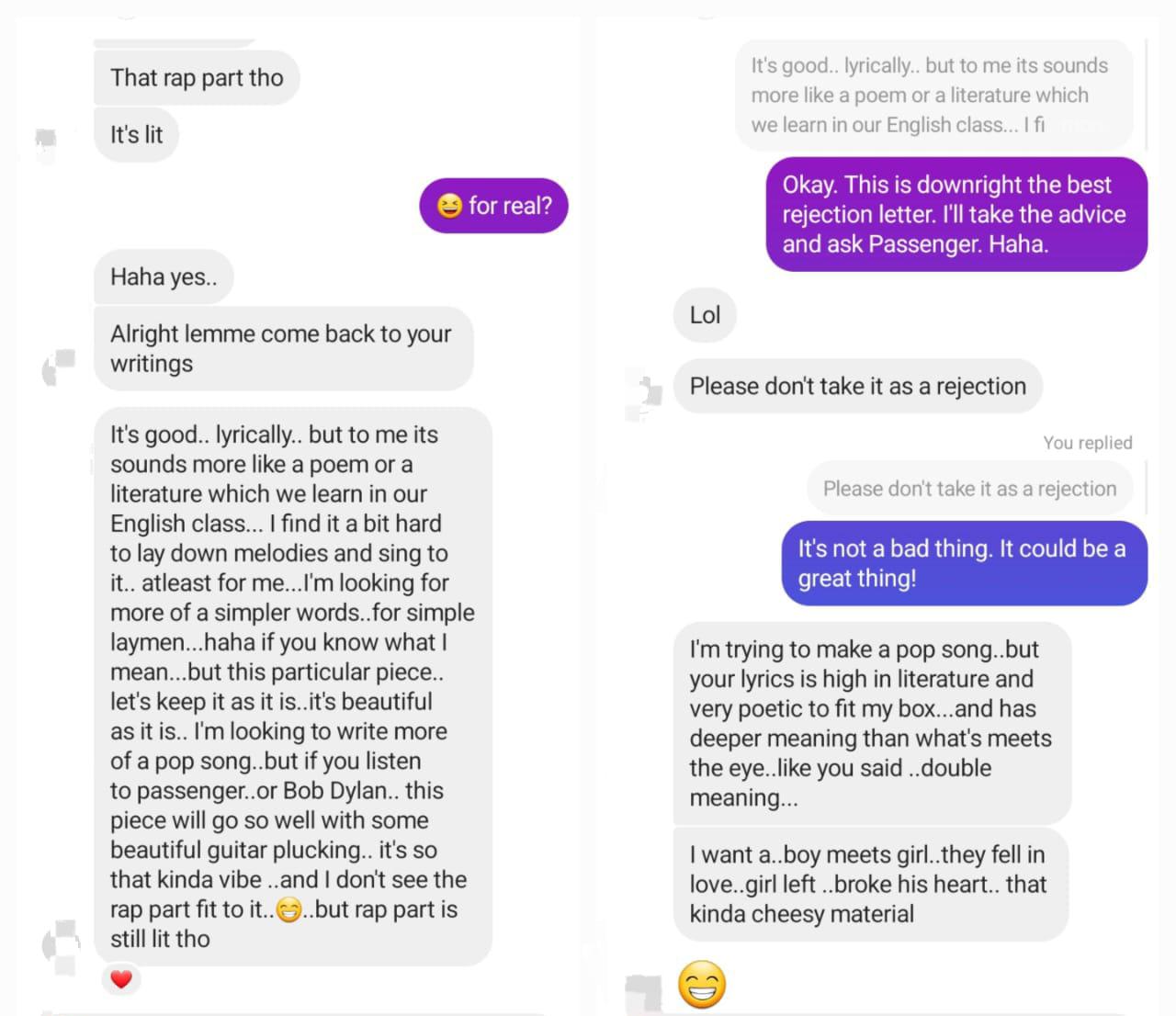
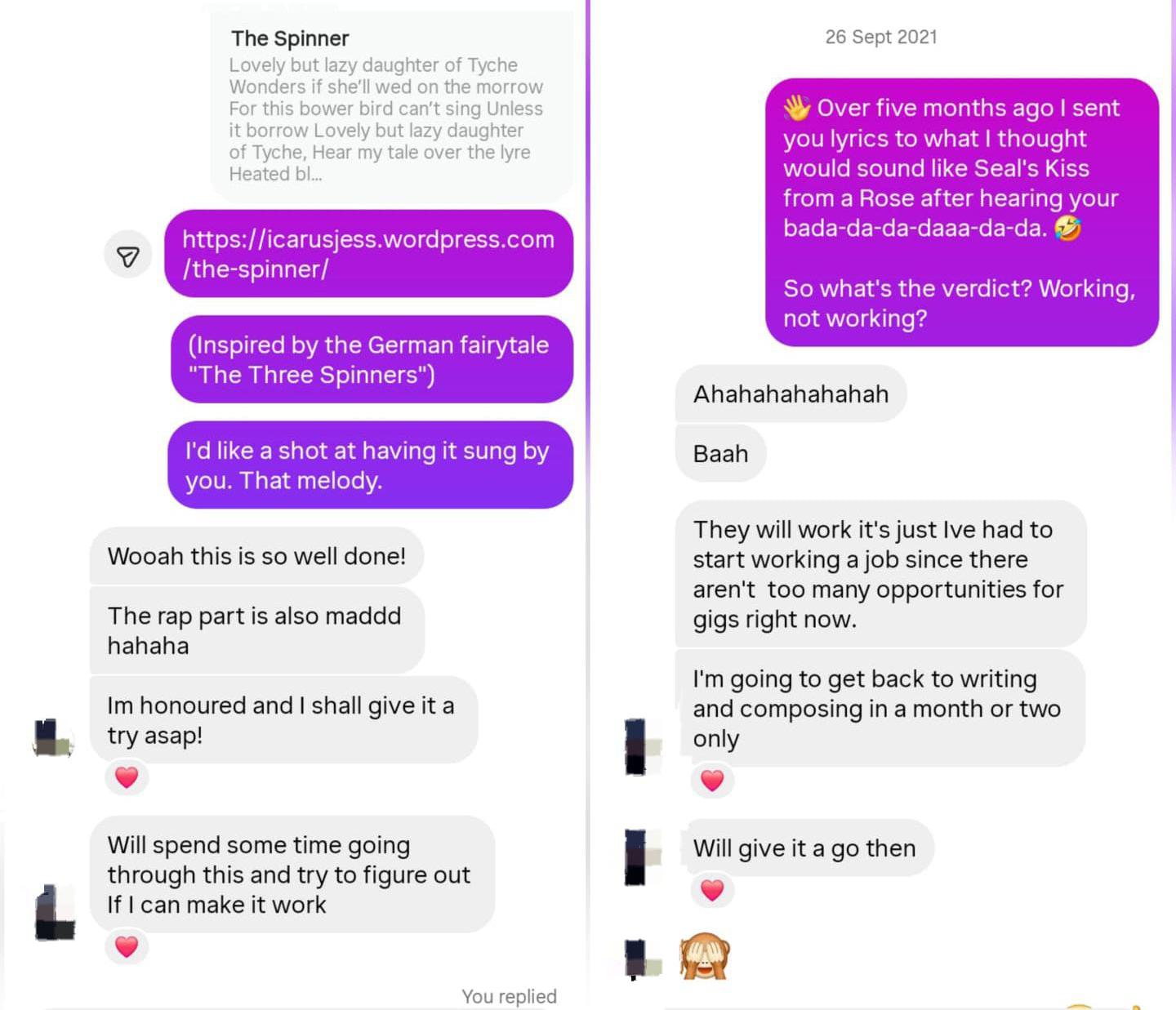
Archival images of polite refusals in 2021
I thought that was the end of them. Until my colleague here took it upon herself to get the talented and funny (comedic) theatre artist Sam-i-naki Passah to pick one of them up. Probably her most challenging script/role and just how did she manage any tears besides those of laughter? In Sam-i’s own words, “Honestly, when I first saw the ‘lyrics’ of ‘The Spinner’, I understood why it was considered ‘bad art’ because I was honestly confused too 😅 however, that’s exactly what piqued my interest and got me excited to work on it… it seemed like such a strange, funny and chaotic piece… and somehow, underneath all that chaos, there was still something oddly emotional there…”
While her rendition has given a song-writer like me much joy and elation, I must admit still more that there was no transformation into something ‘good’; no hidden brilliance revealed. More so, the performance leans into the failure, exposes it, letting every awkward turn show its wonky face in the light. Evidence of trying to force one form into another. And of the strange optimism that skill in poetry (speaking as a poet now) will translate cleanly into another. What I made was unsingable. Structurally absurd and confused. Impossible to smooth out. I think what I enjoyed most was simply seeing an unsingable song stubbornly make it into the world.
“The Spinner” is probably the best worst work I’ve done. Apart from another song co-written with a bunch of fellow 10th (or 9th?) graders during the wave that was Dhoom Machaao Dhoom airing then on Disney Channel India that probably was responsible for an epidemic of girl bands in schools, where groups formed whether the members had talent, half-talent, or no talent at all.
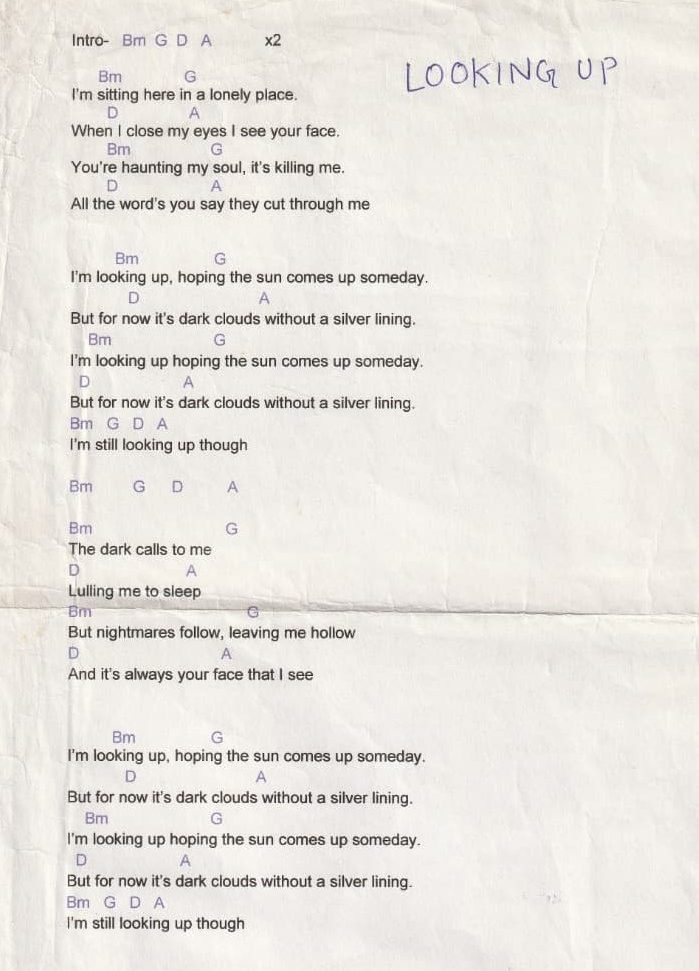
While “Looking Up” came out at an era of Gothic Vampire fiction, “The Spinner” came out of an exciting moment when it felt like the Northeast indie scene was opening up, local artists were beginning to be heard beyond their own circles. I was, briefly, pulled into that current. However, I could not ride that wave.
Today, around me are stories of success, the kind that travel far, like that of artist Eunjae (winning Best Original Song at the 2026 Golden Globe for “Golden”). But I have no delusions. Mine is no such story.
Looking back, I suspect the greater failure wasn’t the obtuse and misplaced lyricism. It was simpler than that. I was trying to write heartbreak without ever having been in love.
There are artists who can take catastrophe and render it with heart, capturing the collective emotion of the time, like Chinese singer-songwriter Han Hong through “Tiānliàngle” writing on the 1999 cable car accident. And then there is William McGonagall, dubbed the worst British poet in history, notably for his account of the 1879 Tay Bridge disaster. Both are responses to tragedy. One transforms emotions and experience into a form that touches hearts, pulling at heart strings, while the other exposes the limits of expression (but tickling hearts nevertheless).
I suspect—alright, I know with good judgement—”The Spinner” is closer to the latter. Not because I lacked feeling entirely but because I really had no idea that I had no real understanding of what I was writing about. It was a generous assumption on the pop star’s part that everyone in their 20s has known romantic love and heartbreak at least once.
What I made didn’t quite become music. It refused melody by resisting genre, sitting awkwardly between yearning to be laid out on the music sheet and execution. And yet, it didn’t disappear.
Seeing it performed by Sam-i, neither corrected, nor improved, but exaggerated, felt like a different kind of arrival (also the title of another rap song I’ve written). It succeeds in staying alive and unchanged, carried, if anything, by borrowed talent.
And that, I think, is how a tribute to bad art is best made.
Thank you, Sam-i.
Sam-i-naki War Passah is an actor and theatre practitioner from Jowai, Meghalaya, currently based between Mumbai and Meghalaya. Trained in acting with a foundation in Meisner technique, she has worked in stage performances, short plays, and performance workshops. Alongside acting, she also teaches and coaches performance, working with both children and actors in training. Her work often stays closely connected to her cultural roots, and she tries to balance storytelling between her home in Meghalaya and the creative space she has built in Mumbai. She is passionate about theatre-making and creating work that feels truthful, playful, and alive.


This was such a fun read and a fun watch! Would love to know about these artists’ work.
LikeLike
Here’s my email – jovie11lyngdoh@gmail.com
LikeLike