
Aditya Shiledar
I) Pilot (/Introspective)
The days of revelation are over. We have buried what we could not forget, and we have moved on with what we could not prevent. Still, there are days, there are moments which shine like eyeballs in a dark room, full of muffled whispering. There is the day of the first broadcast, during which we were present; or there is the day Timothy disappeared, dark and full of foreboding.
But best to start with the day of the gala dinner. That, after all, was the day we first saw the SAIL Building in its full splendour.
Looking back, it feels as if SAIL has always been there, primordial and predecessorial, its octopoid legs well into the soil we’d only just landed on. Even the five-year old riding a tricycle in his gated community’s garden will tell you, with shining eyes, that “the Society of Authentic Indian Literature was created to promote and advance the cause of literature in Our Great Country”, and proceed to recite its five aims to you.
And you will be unable to stop him.
Do not ask him what year it started. SAIL was there when he was born, and SAIL will continue to exist when he dies.
Our invitation to the gala dinner was actually quite serendipitous. We ran a literary magazine called Feldspar which, suffice it to say, was the most widely-read literary magazine in the country at that time—we had a readership of nearly a lakh, and brought out print issues even in that day and age. The few actual bookstores that did exist were Friends of Ours, and diligently stacked our issues on their display shelves.
Now, there were invitees and there were attendees, and we were privileged to be the former. The latter, as far as we could make out, consisted of writers, academics, publishers, journalists, and even some young students who had paid a hefty fee to be ‘part’ of the ‘action’.
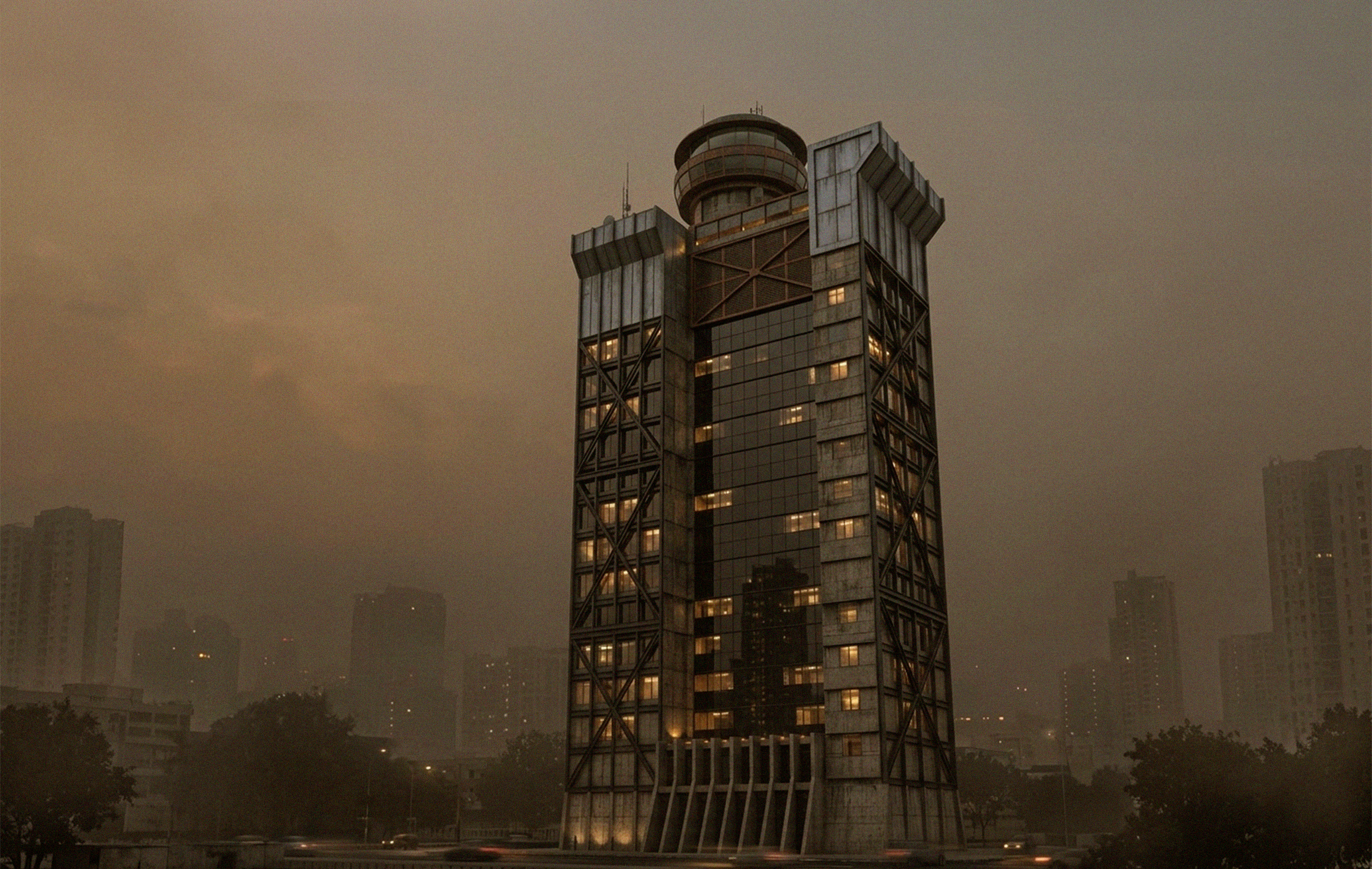
The dinner took place in the vast lawn adjacent to the SAIL Building, which was an enormous affair, some thirty-two storeys high, with a black glass façade and long X’s sideways (perhaps as a nod to the John Hancock Centre in Chicago?). The X’s, we were told, would glow in a very specific colour at night. For months, we had been seeing the building go upwards and upwards, like a plant reaching for sunlight; and then, like a giant monster that needs to be clothed, the glass cladding had come up.
But now that it was complete, we all felt relieved—perhaps even a little proud of it! The only problem was the very unpicturesque terrace, along which ran a row of little serrations, like fortifications on a castle. It was obviously meant for the terrace viewing experience, but from below, it looked like a minimalist skyscraper surmounted by a castle-top.
There were a few X’s too many in this building.
And yet, nobody really cared, because by that point of time, we were all drunk with the hopes of a secure literary future. And the SAIL Building had been an actualisation of just that. Sometime in the late 2020s, the existing literary Academy had been dismantled; and with no central governing body of literature to begin with, the arts had been battling an unjustly harsh winter. How was a country’s literature to flourish without any State support? How would we be represented on the global level, what recognition, what validation, what respect would we have in the eyes of the world? True, there were literary magazines—like ours—and there were independent literature festivals; but without any national representing body, we were like worms blindly struggling for sunlight.
And then, a few years ago, SAIL had come up. The Society of Authentic Indian Literature.
At first, those of us from the wider literary fraternity were concerned: what exactly did ‘authentic’ mean, and what was it supposed to imply? That they wanted to create a corpus of ‘authentic’ Indian literature, and weed out all else that wasn’t ‘authentic’? What was their intention? Would there be new prizes each year, new grants for young writers? Would they follow in the footsteps of the old Academy? What really was their game?
At the same time, you understand, we were clutching at straws. Any State support would have been invaluable at that time, and the gala dinner that night was a representation of just that. The Prime Minister was indeed present that night, and we saw him cutting the ribbon, while a slyly grinning Home Minister looked on. We were part of the umbrella-buttressed invitees occupying the front portion of the lawn, and could see the proceedings well enough; but the others—the attendees—had unwittingly been pushed to the back, from where they could see nothing.
And suddenly, as if on cue, the whole glass façade of the SAIL Building transformed into a sort of screen on which the Prime Minister could be seen live. At that, everybody lost it. There was a humongous amount of cheering from the back, followed by a thunderous applause and confetti-bursting. In the ensuing clamour, the waiters with the entrées couldn’t really decide what to do with their trays, so they ended up resting them on the empty seats (there were plenty of them in this part of the lawn). The cheering was certainly more restrained on our side; people were more interested in conversations and the paneer-tikka dish that was being circulated. Gradually, the discussion veered round to whether the honourable PM would make any address or not tonight, and if he did make an address, what vision would unfold for our country’s future?
He, however, left the premises. Must be busy, we told ourselves, and went on munching the paneer. After that, there was a forgettable little address by the Home Minister, in which he stated that the twin aims of SAIL were to provide a full-fledged literary body for our country—thus confirming our previous conjectures—and to restore the lost literary heritage of Our Glorious Country, which had been ransacked and plundered innumerable times by Invaders from Foreign Countries. The rest of the night followed aimlessly, and the multitude soon dissolved into thick strands of people heading hastily for dinner. As the fireworks erupted at the end of the evening, and the SAIL Building began to glow in refulgent red shades, hope was at its highest pitch, and the future of literature seemed as safe as a seatbelted entity.
II) The Prime Minister’s New Clothes
Looking back, we realise that it was a sort of eventuality: SAIL was the literary endeavour that crushed all other literary endeavours. Just as the SAIL Building managed to put together a whole mélange of styles without really making a statement of its own, so the Society of Authentic Indian Literature was starting to sound more like a parade than an organisation. It belonged more to the realm of legend than fact; there were whisperings and headlines, donations and gratitude, and we kept waiting for the big announcements to come, for the literary ‘heritage’ to start reviving.
One shadowy evening, the first broadcast came out.
Everywhere on the internet, people went crazy. You could see it happen in the metro: everybody got notifications at the same time, and half of them probably didn’t even know literature beyond garbled schooltime notions of Shakespeare and Tagore. Still, they all plugged in.
We were lucky enough to have been invited to the studio for a special viewing of the broadcast; it would turn up as a feature story in our next issue. The studio where it all took place was situated high up in the SAIL Building, where we were escorted with uncommon haste through a tangle of elevators, corridors, and passcodes. The energy shift was obvious; everybody here was somebody, and as the hour for the broadcast approached, visual language became paramount. The murmuring sank; the foreheads became tense, and the makeup artist tending to the Prime Minister (who was standing under a spotlight) slunk out of view.
Umashankar, the head cameraman, eased his collar-buttons, and after a panoramic glance, uttered the cardinal words: “Lights! Camera! Action!”
“Brothers and sisters!” thundered the Prime Minister, his nasal baritone already jarring, “Today, we are here to celebrate a very special occasion: the phounding of the Society oph Authentic Indian Literature” (a grave pause) “This Society” (narrowed eyes) “will impact the lives of each and every Indian phrom today onwards. We will now rekindle the glorious phlame of our ancestors’ greatness!” (Breathing pause; but really, he just glares) “The Society will cater to everything our country’s literary industry has always lacked! No longer will our writers be phorced to work in the dark! Phrom now on, no more small magazines” (here he waggles his fingers with a big grin), “no more small pablishing houses!” (again the thumb-waggle), “and no more literary phestivals either!” (more grinning). “All is One, and One is All. Like one big jahaj, we shall take Our Country phorward together, and ride in one sea, go by one speed! Our newly phormed Society will give each and every Indian a big chance!” (now the index finger is raised, as if driving home a point), “There will now be no need phor them” (another grin) “to phorm groups or clubs, or try to pablish themselphs separately.”
“No, no, no!” (now he is in his element), “the Society will look aphter all this. It is their duty to do so. As the Prime Minister oph this Sovereign Country, I guarantee you that your work will be treated well, and given the recognition it deserves. Phrom now on, all writers will be looked aphter by the Society!”
While all this is going on, a little boy suddenly enters the room. He walks over to Umashankar with something between timidity and fear.
“Papa, papa!” he whispers.
“What is it!” the panic-stricken Umashankar lowers himself to the boy’s level; he is already regretting bringing him to the office. If only his wife hadn’t left for Australia so suddenly! But then… she was there for a conference on the Indian Knowledge System…she couldn’t be blamed.
“Is that the Prime Minister?”
“Yes, he is.” And despite his tense position, Umashankar feels a broad smile suffuse his features. It is like the sun; he cannot resist it.
“But papa,” the boy presses on, “why isn’t the Prime Minister wearing any clothes?”
“Shhh!” Umashankar hisses, so audibly that even the Prime Minister shoots him a glance. “Go watch your cartoon in the lobby outside!! Here, take my phone!”
“But papa…” even as he keeps remonstrating, a woman—probably an assistant—gently and soundlessly leads him out of the room. The phone is still in his hands as the door closes.
The Prime Minister goes on.
“In time,” he is almost castigating the viewers now, “we will not even need translators in Our Country. The Society will see to it that we have an excellent translation database, as well as interpretation centres all over the country. But most importantly, we must standardise our languages. Diversity is always going to be there; it is we who must try to get over it!!” (a momentous pause; he wants that to sink in).
“And now!” (the index finger is back) “I would like to introduce our Great Friend here, Mr. Balcon, who is a TV host and a great reader always keen to discuss ideas”. As the Prime Minister moves aside, but not out of the spotlight, another man—shorter, rounder, balder—emerges on the spot. His appearance is just like that of Henry James in the 1913 portrait by John Singer Sargent, but without that penetrating, contemplative gaze. Instead, he has tiny reptilian eyes that dart from this side to that, as if anticipating some attack. His mouth has the unctuous look of the man behind the sweet-shop counter who knows, with pulverising certainty, that each of his products is going to sell.
The Prime Minister goes on:
“Mr. Balcon will host his Midnight Talk show with our writers every Saturday. He will interview old and new writers, and talk about the writing laiph. But most importantly, he will make literature accessible to each and every one oph you!” (His tone, first rebarbative, is now almost persuasive) “No longer will literature be the domain oph a select phew! The common man will no longer be pushed aside by the likes oph you! Soon, our literary culture will become the phirst in the world! Mr. Balcon’s talk-show will elevate our status as the most giphted country in the world!” (again the fist is raised) “For us, literature is a religion, just as religion is our most sacred literature. And in time, the world will know it. It will know us phor what we are—a global superpower that can produce halph the world’s literature!! Soon, we will aim to be the world’s third largest producer of literature!! In time, India will rise—and rise to be the world’s leader!!
Thank you!”
The whole room burst into a steady stream of applause, and for two minutes straight, neither the Prime Minister nor Mr. Balcon could move from their spot; a lady came, and hung a garland around their necks. Then suddenly, everyone swung into action. Yet the movement was less hurried, less anxious now; and Umashankar even managed a small smile as he enquired after his child.
News channels and headlines were full of the broadcast the next day; the barrage of anticipations continued for a week. Yet most of us from the wider literary fraternity were uneasy about this. It is true that recognition is the artist’s manna; but to what end? We were content in our cozy corners. We did not want a fancy Society to represent us. And then again, when has democratising a particular vocation made it more valuable? Writers work best when they work in the shadows. Drag them into the limelight and half their joy evaporates. We mean the joy of poetic composition, of watching word weave into word, until the whole embroidery becomes transparent—what matters is only the effect, the way the quilt feels over the body, and not the way the quilt has been weaved. Art that draws attention to itself as art is not art; it is posturing.
Still, it is not every-day that you see the Prime Minister of a country advocating literature as a country’s prowess. To us, however, it just meant that we were now more alone than ever, because even our last resort—our creative expression—was now to be ‘looked after’ by some higher authority.
It meant that we’d have to keep our eyes and ears perpetually open.
III) Tomorrow, and tomorrow, and tomorrow
Gradually, the tangled skein began to unravel. We knew that before long, we, too, would be pushed into further acquaintance with SAIL. We knew, too, that before long, Feldspar would have to change —in some significant way. Already small publishing houses were ceding control to the Society; magazines like ours would take the next hit. What would we do then?
Just as we were launching our next issue, something happened. We received an email from SAIL. It said:
‘Dear Feldspar,
Greetings from SAIL. As you are well aware, we are currently seeking major literary voices from across the country to participate in The Midnight Show with Mr. Balcon. Given your prominent position on the country’s literary scene, we would like you to be part of one of these sessions. Kindly choose a member from your team to represent Feldspar on TV. Please write to us when you have done so, and we will apprise you of the ensuing procedure.’
It was what they call a ‘directive’, yet it arrived so easily and effortlessly that we were quite flummoxed at first. Then we began thinking of possible candidates for the show, but it wasn’t a difficult decision. Almost unanimously, we thought of Pramod, the visual editor of Feldspar. Pramod was the oldest and the most experienced of us all. He’d been alive during such far-off events as the COVID-19 pandemic, and even the Emergency; he’d worked in two other magazines before Feldspar had come up. With his dappled grey hair and his cymotrichous grey locks, Pramod was easily our safest—and cleverest—bet for the show.
On the evening we were about to send in our response to SAIL, Pramod was hit by a speeding SUV while returning home from his walk.
It was devastating. It was cruel—a sort of poetic injustice that the very man for the job should turn up dead when we most needed him! We set aside all our literary functions for the moment. The magazine was unquestionably on a hiatus from now on, and it did not seem as if our pains would be eased any soon. But barely a few days had gone by when SAIL asked us to hurry up.
We decided on Timothy, the marketing and outreach manager. Tim was the youngest, but also the most suave and sharp-spoken. He could turn a question to his advantage the moment it’d been spoken; and his demeanour could impress as well as intimidate. Little Tim was overjoyed to hear of his nomination; but when we reached out to him later by phone, there was no answer.
That was strange. He’d been with us just a few hours ago. Other pathways, like email or direct messaging, did not work, either, and the following day, when one of us went up to his apartment, the charwoman said that not only had he not been there for the past few weeks, but that he had probably shifted. The padlocked door looked obdurately dusty. After three more days went by without any sign of Timothy, we began considering withdrawing our candidature, when we received yet another email from SAIL! It was the shortest communication we’d ever received from them. It said:
Timothy is safe. Please prepare your editor-in-chief for the talk show session. No more delays will be allowed. Other details will follow.
A strange period began for us. It was as if we were occupying a house that was continually being set on fire; every room we crossed turned up in flames. Evacuation wasn’t a choice; the world outside was on fire too. It was just that the fire had reached us now; hitherto we’d been safe.
Udbhas, the chief editor, was a thin, wiry man, always decked out in turtleneck sweaters and chinos. His dedication to the magazine was legendary; he’d once sold an ancestral Mercedes S-class just to make sure there were enough print copies. Mad, bad, and dangerous they called him, just like the poet who died in the Greek War of Independence. Yet Udbhas was no poet; he lived a gloomy life in his twelfth-floor apartment, situated in a distant corner of the city, managing a thrifty hermitage.
We began to worry about what the email was doing to him.
Our operations at the magazine had completely ceased by then. We no longer worked. As for cold storage, what few contacts we had were with Timothy, so they couldn’t be accessed. It wasn’t long before we found out that we couldn’t work: we had been logged out from all our accounts, and could not get back in. In one fell swoop, Feldspar had been rendered obsolete. Contributors would soon start pulling back from the submission race. It was like being put under house arrest.
And then, on 16th December 20__, they finally got to Udbhas.
What follows is an imaginative reconstruction of what must have happened to him. Of course, what really did happen remains uncertain; in matters where the State is involved, one can never be sure. But it is true that after his capture, Feldspar never really returned to its original form again.
Read the rest at your own discretion.
IV) Chimes at midnight
On the eve of 12th December, 20__, two SAILors stood counting the minutes on the twelfth floor of a building. A single orb-like bulb illuminated the whole corridor, leaving flat no.1201, where they were standing, shrouded in a dank, discomfiting darkness.
It was 11:59.
“Shall we…?” SAILor no.1 jerked his thumb, motioning at the door. The other SAILor nodded.
Fifty six…fifty seven…fifty eight…fifty nine…
DING-DONG!
They waited.
The door opened with a click.
“Yes?” Udbhas looked tired, clutching a cup of coffee in his hand. He was decked out in a brilliant blue nightgown, with a taffeta sash, and red slippers.
One look at their uniforms convinced him of the futility of escape.
“So,” he managed to say, “you’ve come to get me at last.”
SAILor no.1 nodded.
“I waited for your email—I waited a long time!”
“We’re sorry for that.” SAILor no.1 smiled unapologetically.
“Do I have to come with you?”
“I’m afraid so.”
“And there’s no way out of this?”
“I’m afraid not.”
“Alright…” he tried to smile, but it came off as a bad replica. “But can I at least finish my coffee before we leave?”
“Sure, take your time. We’ll wait.”
“Why don’t you wait inside? The corridor’s…pretty bad.”
The SAILors apparently agreed, because without any ado they stepped in. Inside was an otherworldly world of olde-world charm and beauty. The hall was bathed in a discreet yellow glow, which came off rather prettily on the polished wooden furniture; a complex glass chandelier stood sentry on the ceiling, while the carpet felt like grass, but was mushier. The sofa offered refuge; they sank in it like heroes from a battlefield. The TV was playing Casablanca; their eyes trained themselves to it.
Udbhas promptly disappeared into the kitchen.
SAILor no.1 suddenly sat up. What the hell were they doing here?! None of this was scripted! It was getting human, all too human… it had to be terminated.
They headed to the kitchen, where Udbhas was bending over the fridge, doing something with a cup of milk. The first blow caught him squarely in the neck just as he’d raised his head to see them coming; he fell over into the kitchen sink like an upturned lizard; and before he could stand up, they had already thrown a little noose around his head, dragging him down on the milk-bespattered floor. “Aaagh… you fuckers!” he could barely scream, as he felt the sharp cord singe against his throat; it went on tightening and constricting round his throat, tighter and tighter, until all he could see was the ceiling fan rush at him like an enormous cicada.
Then followed oblivion.
V) Till human voices wake us
It was pitch-black when he woke up. He reached for his phone, but it wasn’t there. No nightstand, either. Something moist kept twitching against his thigh, continually, inconsolably, like a child’s insistent finger. It was an erection. He tried to sit up, but his head hit something; he tried to feel it with his fingers. It was a sort of wall. He tried again, this time going on all fours, and when he put his hands up, there was no wall.
He could stand.
And then, it all came back to him—last night’s events. He’d been watching Casablanca, Rick was about to meet Ilsa for the rendezvous, and then…and then…What had happened after that? The space around him was all dark. Helplessly and impenetrably black. There was no sound, either. He tried to walk—with one arm extended—and soon found out that there was another wall three steps ahead. So he was walled in. Great.
Then a voice spoke from a corner of the room: “You may put on your clothes.”
It was then that he realised he was naked. Panic began a drum-roll in his head, and as his hands slipped around his pubes, he realised he was cold—cripplingly and cadaverously cold.
“Here,” a bundle of clothes flew at his head. “Put them on.”
A small LED bulb turned on overhead, like the one in the attic in Psycho. “Aha!” he exclaimed, “what was that?”
The door opened, and SAILor no.1 walked in.
–Please sit, he ordered.
Udbhas sat cross-legged on the floor.
–Do you have any questions?
Udbhas blinked rapidly. “We’re inside the SAIL building right now, aren’t we?”
SAILor no.1’s eyes softened. Yes, he admitted.
“Which floor are we on?”
The twelfth.
“And is it true that you have no windows in this building?”
At this, the SAILor permitted himself a smile.
-Yes, we can get by without ventilation.
“And…is this where your interviewees end up? In this dark, cold prison cell? Do you then brainwash them for the interview? Is that how you plan to strangle the creative spirit of the country? God, I have so many questions!”
–But, the SAILor smiled pitiably, I have only one answer.
“Which is?”
-You’ll find out soon.
The enigmatic smile never left his face. Over the next few days, it only deepened, like ruts in a track that hasn’t seen rain in months. Udbhas’s stay in the prison, though, wasn’t wholly or even partially uncomfortable. They made sure he had access to TV, putting The Midnight Show with Balcon on repeat—just, they said, to acquaint him with the drill. Soon, he developed an antipathy to the very idea of the show, and the mere sight of Balcon’s rotund, smiling face could elicit such degrees of disgust from him that the prison masters could no longer ignore it. One day, SAILor no.1 burst into the cell, his eyes bloodshot, his hair ruffled, and his face contorted by a look of utmost consternation.
Why are you like this? he demanded, why can’t you cooperate?!
They were standing in the centre of the room, and the bulb was making its utmost efforts to aid Udbhas in his understanding…
“You are the one forcefully holding me here! When can I get out, what will happen to my magazine?!” but even as he began pacing up and down, Udbhas was suddenly seized by a growing sense of terror. The man under the bulb was starting to look familiar; it was an old face, quite transformed, but familiar nonetheless…and then, suddenly, it came to him, like a photographic image sliding nimbly out of the printer. Why, it was Timothy!
But at the same time, there was something wholly unrestrained and unrestrainable in this man who was Timothy, which had not been present in the previous Timothy. It was as if a part of him had been subtracted, and a newer, more unyielding part had been added to him.
But the moment was gone the second he’d stepped back from the light. All things, Udbhas made a mental note, appear significant under the spotlight. Now that he had stepped away from it, he was just one tired man confronting another.
Timothy turned back into the SAILor and walked out of the cell.
Yet as the days passed, Udbhas gradually began to feel more at home in the cell; there were no distractions here. At times, a distant image of a room in a building—many rooms, in fact—kept coming back to him, but he couldn’t quite swim his way back to that memory. In the end, he decided, it must have been his own invention. But there were other beautiful things happening to him now. He no longer frowned at Mr. Balcon’s face the way he did before; it seemed respectful, even benevolent to him now.
Winter kept him warm, covering him in forgetful sloth; and he began to grow healthier. Indeed, the SAIL Building’s resident patient, Dr. Balkan (not to be confused with the similar-sounding talk-show host!) declared him to be rapidly improving; he’d been monitoring him for quite a while, and was soon ready to have a tête-à-tête with him.
When the day arrived, Udbhas was escorted to the doctor’s clinic clad in a synthetic white gown. To be sure, the gown felt a little uncomfortable in his armpits; but he’d learnt long since that to question was to invite trouble. So he brushed off the voices, like bread-crumbs from his cheek, and stepped cheerfully into the clinic.
“I have an announcement to make,” the Doctor smiled. “Please have a seat.”
Udbhas sat.
“You are aware, no doubt, what we are here for. We are the Society of Authentic Indian Literature.” And as the words tumbled out of his mouth, an image—faint, ephemeral—started tugging at Udbhas’s mind.
“I’m sure,” Dr. Balkan went on, “that you know of the Foreign Forces invading this country” (Udbhas began to nod, slowly, deliberately), “You are also aware that to fight them we must have weapons of our own. Do you follow me so far?”
“Yes.” Udbhas gulped.
“Now, you, Udbhas, are a weapon” (another gulp) “and we have prepared you for the fight. The fight to save our country from…”
“…foreign invading forces!”
“Exactly.” The doctor smiled. Slowly, he began tugging at his hair; it looked quite funny at first, but soon, something happened—some past image, perhaps, suddenly came back to him. But of course! It was the face he’d seen so many times on television!! It was good old Mr. Balcon.
“You,” he continued, “will represent Our Nation on the TV. You will act as the editor of our new magazine, Sanskar, on my show.”
Udbhas couldn’t believe it; there were too many images now before him, but only one stood out prominently amongst them: the one in front of him.
“You must make a speech that day, Udbhas. Do you want to read it first, in front of me?”
And as he paused for a moment, Udbhas could imagine the kind of effect the speech would have on the viewers. He would be on national TV! Everyone would be awed—including even the Prime Minister!! He felt a frisson of delight flow through his body.
“What happened?” asked The Host.
“Nothing, nothing…” murmured the new Editor-in-Chief.
The enunciation began.
Aditya Shiledar is a writer and researcher currently pursuing his postgraduate degree in English Literature from the English and Foreign Languages University (EFLU), Hyderabad. Perennially hopscotching between books and cities, Aditya is attracted by the mundane and the interstitial, and likes to call himself a ‘journalist of lost aims.’ His writings have appeared in the Gulmohur Quarterly, The Hitavada and the NCPA’s ON Stage, among others.

