
Anuja Dutta

Looking back in time is a tricky affair. The memories seem occluded, marred by counter-memories and the unmitigated distance of childhood. Even so, the incident of how I retrieved a maternal aunt—a memory long-gone and effaced from the palimpsest of dominant family histories—was a relatively simple one and began with an invitation to lunch. The invitation was preceded by a death. A great-uncle on my mother’s side passed away due to the vagaries of old age. Relatives briefly reunited on the occasion of customary funeral rites. The event was neither exceptional in the emotional charters of grief nor particularly memorable.
Next day, my mother received a phone-call. Thenceforth, they became more frequent, more lingering. I would see her talking to whoever was on the other side a little more enthusiastically and a little longer than the usual limit of quotidian domestic calls, mostly from my father and me. One day she bluntly thrust the phone into my hands mid-call and said, “Runu maashi wants to talk to you”.
“Who?”
“Your aunt”, she replied, completely dismissing my curiosity as if I was logically expected to understand the identity of this person. I honestly don’t remember the full length of our conversation, except parts where my aunt emphatically spoke of my mother being extremely ghorkuno—a homebody, an obsessive creature of the domestic, unwilling to move limbs to go anywhere.
“Drag her out of the house and come visit me. It’s just one auto. I’ll cook.”
Later enquiries into my aunt revealed snatches of memory about a period in my mother’s life where she almost presumed her father to be dead. The incident went somewhat like this: decades ago, when my mother was just a girl, my daadu (grandfather) was drugged and abducted one night by some nefarious elements in the family to crudely resolve some stubborn property feud. Under the influence of a drug-addled consciousness, he was made to sign blank notarized papers. As my mother’s memory goes, it was a more-or-less non-confrontational, almost cordial attempt at kidnapping. By the time he was dropped back graciously by a car at his home during late hours of the night, irreparable lineal damage had been done and the property feud, finally settled.
As hushed networks of conspiracies go, my great-uncle—whose funeral set in motion this unexpected reconnection with my aunt—was rumoured to be in silent cahoots with his nephew, the chief architect of the plan. Probing further into my mother’s memory revealed that on that winter midnight, daadu was accompanied in the car by his elder brother—Runu maashi’s father. After getting threatened to sign away his only home at 10 Nandana Park, my daadu refused to stay there any longer and soon shifted to his wife’s—my didaa’s maternal home in a non-affluent colony in Behala. My didaa, refusing to bear the brunt of humiliation as a sheltered couple, insisted they live as tenants in her own home. Familial relations on my daadu’s side considerably strained after that. When asked how exactly Runu maashi’s family featured into this troubled equation of displaced homes, my mother recalled that it was my aunt’s family who had arguably sheltered their treacherous cousin after this incident took place. My mother suspects an element of coercion probably had a role to play in this sheltering but the objective picture of assistance it portrayed to her immediate family was enough to sever ties.
Decades later, the family would reunite under the pretext of another social ceremony—a joyous one this time—but I would have been a wee kid to correctly recall the occasion where I met Runu maashi for the first time. Later, she would describe to me how I acted like a wilful child that day and resolutely refused to share a seat with her, pushing her out inch by inch and claiming my territory of comfort all for myself. Years later, at a funeral, I would meet her again—a more agreeable adult this time—where her face would appear completely new to me.
I was excited at the prospect of uncovering a whole new individual in my mother’s life of whom I knew nothing, except that she was my mother’s cousin and did not particularly live too faraway. A gentle jolt of indignation rose in me when I once asked my mother why we, in all my extensive years of childhood, never once spoke of her existence, let alone visit her. What followed was an unearthing of the story I just described, in sharper relief. Strangely, my mother’s recounting of personal history did not seem too marred by animosity or bitterness, just an easy-going detachment to relations long-turned nebulous due to generations of convenient silence.
“We must go visit her”, I concluded with an air of finality to my mother’s lukewarm enthusiasm. She did warn me of my aunt’s propensity to chat without ever tiring, and losing track of time. That explained the long phone calls. Runu maashi lived alone. Her father died after sustaining a head injury while going up the stairs. Nobody knew how he injured himself. He was found unconscious and bleeding on the second floor staircase. Despite being moved between hospitals, nothing more could be done. Her mother died shortly after from cancer. This happened during the late-nineties. I was just five years old then. To me it seemed mind-boggling how effortlessly my aunt had aced lessons in loneliness and violent deaths while carving an existence in solitude for twenty-six years, tempering it with growing green chillies in her apartment terrace, figuring out crochet patterns from YouTube videos, and a neurotic need for cleanliness. My mother never loses a chance of making fun of her for her constant need to keep everything spick and span. But I felt a strange sameness with her as I too have developed a phobia of dust due to raging allergies. Also, it felt strangely satisfying to walk around barefoot inside her apartment, feeling the freshly-cleaned cool hardness of mosaic floors beneath my feet, completely dispensing with slippers.
The first thing I noticed about Runu maashi’s flat was its spacious oldness. Thick, whitewashed walls with large rooms and huge paned windows let in ample light but dim street sounds. The kitchen is a breathable space, lined on the right with large, consecutive shelves with absolutely no need for a fan. But the most beautiful aspect of this space is the wooden furniture, the way they constantly throw themselves into chiseled silhouettes against the blinding light from the windows opposite. The near-blackness of wood accumulates character, its smooth polished sheen a delight for travelling fingers, tracing its lines and curves. It seemed herculean to us that my aunt had solitarily cared for these hunks of inert mass by herself, keeping them spotless, never once thinking of selling or exchanging for less cumbersome substitutes.
The first day we visited Runu maashi was an afternoon in winter for a luncheon. My mother insisted on a simple affair as she was against her single sister spending too much on groceries just for entertaining us. Lunch was thus a simple hot meal of steamed rice, ghee, boiled eggs and mashed potatoes with a generous dash of mustard oil, chopped green chillies, salt, and cauliflower floret fritters. I bombarded them with questions of the past, of their long, intertwined ancestry, past addresses of residences, and embarrassing nicknames. The afternoon was long, our stomachs full, our hearts fed, and before our curled-up selves could briskly slip into a siesta, it was time for tea. The winter of togetherness had been deceptively short-lived and evening was fast falling beyond the closed curtains and cozy darkness of the old rooms.
The visitations weren’t particularly frequent as all three of us had our separate worlds and matters to attend to. But a lost connection was forged against old narratives of wrongdoings. So much so that whenever a certain Bangal (East Bengali immigrant) delicacy of dried fish or shnutki maachh was made in our home, my mother made sure to pack her some in a takeaway container and send it by my hands. Sometimes it would be kochur lotir torkari (another East Bengali delicacy made of taro stolon stems); all quintessentially Bengali migrant-household lip-smackers which my aunt wouldn’t normally make for herself because the meticulous prepping seemed too much trouble for one person.
For someone whose life has been foreshadowed by untimely endings, discourses of emotional independence in solitude came intimately tied with premonitions of death. Living alone almost always spelled an impending disaster of sorts. Of the two sisters, my mother isn’t naturally predisposed to entertaining long conversations. It is well-within my mother’s character to postpone communication but my aunt never misses an opportunity to return a call. So, one day, when repeated calls to my aunt’s number went unanswered, my mother was seized by panic, fearing the worst. She immediately asked me to go check up on her the next morning. What would normally have been a surprise visit, turned into a dreaded exercise of measuring hours by minutes. As I climbed the dusty stairs all the way to the top floor, out of breath, and rang the bell, my aunt opened the door—healthy and unscathed. I showered a litany of complaints standing at her doorstep. She politely asked me to come in, assuring she’s very much living and I must have lunch at her place. But since she hadn’t known I’d be coming over, we settled for boiled eggs and mashed potatoes again. The afternoon, spent hunched over old Bengali crossword puzzles, ushered in a storm. My aunt put some water on the stove for tea and cautioned against leaving. She fried some store-bought puffed rice with cumin seeds and mustard oil. I watched her busily fleeting in and out of sight, listening to the clinking of utensils. A soft growling thunder gradually intensified as background noise to a domestic song of survival. Munching on the salted rice, the gloom of death momentarily dissipated.

Runu maashi setting out portions of potato mishmash on Maa’s plate. 
Runu maashi enquires if Maa would prefer some extra salt or ghee as the two sisters sit down to eat after eons. 
Runu maashi’s bedroom. 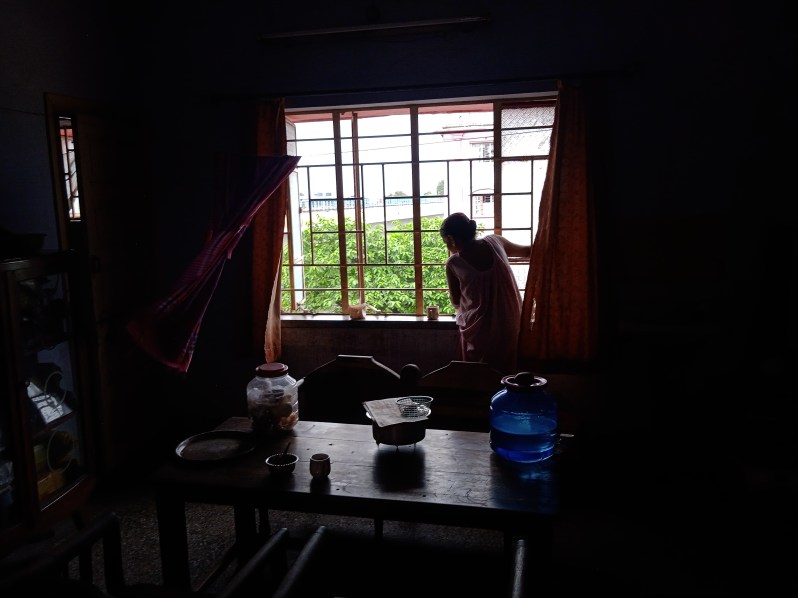
Runu maashi drawing the window-panes shut as water droplets shower in. 
Forever reluctant to show her face or smile for the camera, Runu maashi agrees to pose as a darkened silhouette against a grey sky.
All photos, courtesy: Author
Anuja Dutta is an independent research scholar specializing in the nexus of horror, ecology and space and how they feature in the colonial and postcolonial studies of land in vernacular literature. She is presently working on two separate pieces on folkloric text and horror Westerns in cinema.
 Ptenopus